
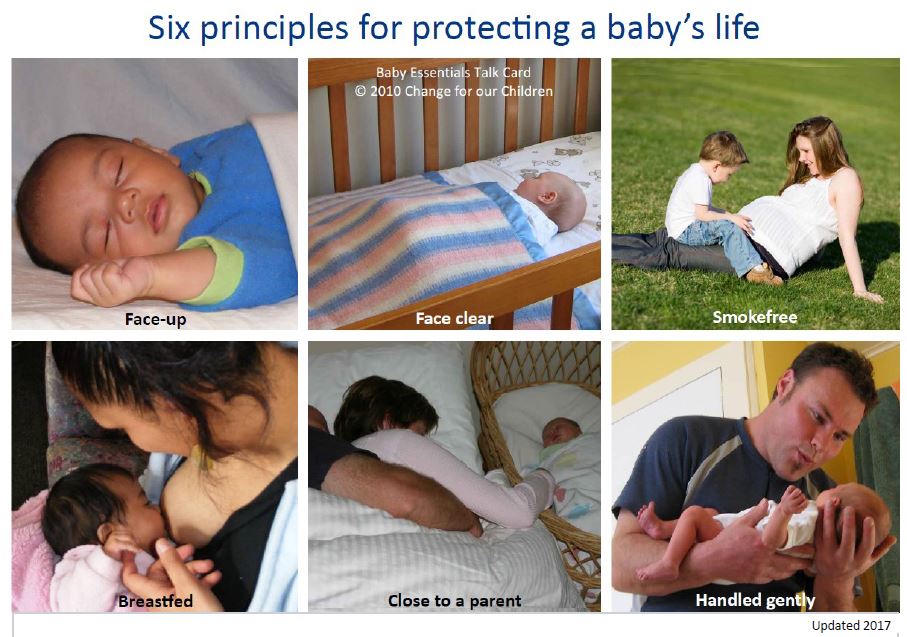
A Talk Card to help shape discussions about what is essential for protecting a baby's life
Safe Start Tools
technical support for Safe Sleep champions
Pepi-Pod® Programme
Sleep Safe, Little One video (Choose option 'open with quickplayer' for best results)
Through the tubes
Presentation - with voice-over
Talk Card for discussions
about preventing suffocation
It matters where you grow
Smokefree Pregnancy Presentation (with voice over)
Baby Essentials
- Presenter's Slide Guide
- Presenters Handouts
Baby Essentials Online (e-Tool)
Six Principles picture Presentation
Safe Sleep
Introduction to Safe Sleep resources
Safe Sleep Leaflet, Cot Card and Poster
Safe Start Education Resource
'Yes you can! leaflet - (using NRT in pregnancy)
Knowledge Match-up Cards
Safe Sleep for Babies prepared by Auckland University to explain infant airways risk.
Tool Kit
Why are we so passive about the deaths of our babies?
Every year, sixty New Zealand babies would die sudden unexpected deaths as they slept, until recently. Most babies who die this way are well and most of their deaths are preventable. Would we accept 60 deaths a year of healthy people from any other age group or for any other reason? We are shocked as a nation when children die at the hands of their carers, when teens are cut down by dangerous driving, when young ones take their own lives. And so we should be. Is it the loss of life that shocks us or the circumstances?
We legislate to protect our children from drowning and from harm when they travel in cars. Yet we are casual about the safety advice of 'face-up, face clear, smokefree' to protect a baby as they sleep. For babies, unsafe sleep is the single greatest preventable threat to their lives. Sudden unexpected deaths in infancy (SUDI) are silent. They do not make the headlines and are invisible to the community at large. The greater burden of loss is borne by the baby and their family.
Time to say goodbye
Now is the time we say goodbye, not to our babies, but to our apathy about their vulnerability, our tolerance of their deaths. It is time to farewell our ambivalence about sleep positions and our reluctance to challenge unsafe practices. It is time to move on from infancy being a stage of development shrouded with risk, and time to welcome a new era of 'survive and thrive' for babies and 'hope and confidence' for parents.
The new era
In the new era of protection, every baby is safe every time and in every place they sleep. They are safe to take their rest, have their dreams and wake, because every family knows what makes them vulnerable and every family acts to be sure they are safe. To create this reality we need to align a nation with the principles for protecting a baby's life and enable families to act to protect them. This is the purpose of the Essentials effort.
Sleep space work
Since 2010, Change for our Children has introduced the Pepi-Pod® Programme to help address inequalities in preventable infant mortality, especially for Māori. Born as a 'sister' to the wahakura developed in Maori communities, the Pepi-Pod® sleep space made its debut as an emergency baby bed following the Christchurch, NZ, earthquakes of 2011. In 2016, it is now an established service for more vulnerable infants across the country, supporting the wahakura to achieve a scaled up protection effort. It is a likely contribution to the falling infant mortality we now see in NZ, especially for Māori infants.
Terms
Safe Start is the overall programme of Change for our Children for promoting a safe start to life.
Baby Essentials is our professional education and
Through the Tubes and
In Safe Hands our current foci on preventing the group of deaths due to accidental suffocation and alcohol misuse, respectively.
Safe Sleep is the term we use to focus our community resources. The
Pepi-Pod® Programme is our enabling intervention working with priority communities to strengthen safe sleep awareness and action where it is most needed.